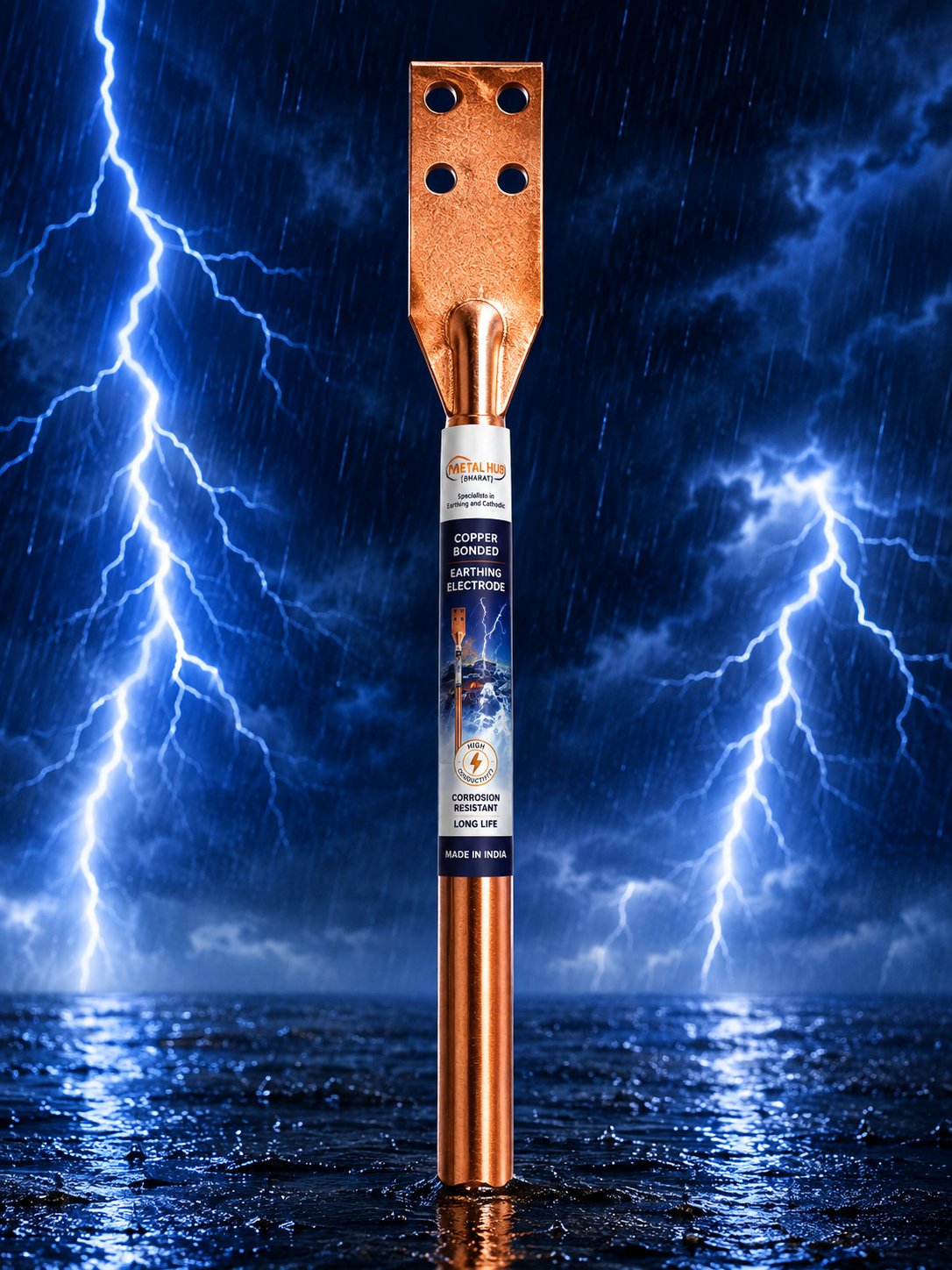
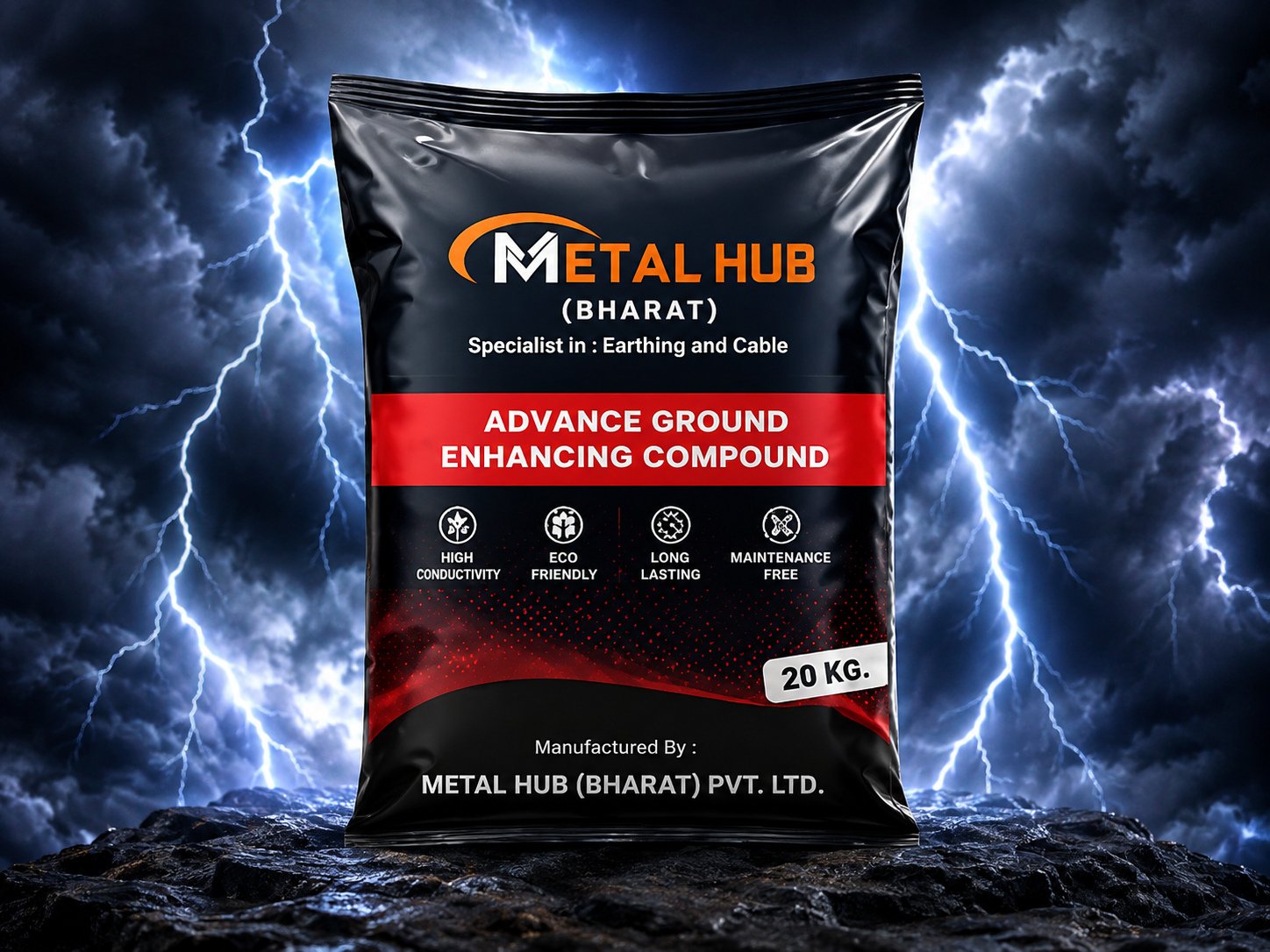
The dependable workhorse — hot-dip galvanized electrodes that deliver reliable, maintenance-free earthing at an economical price.
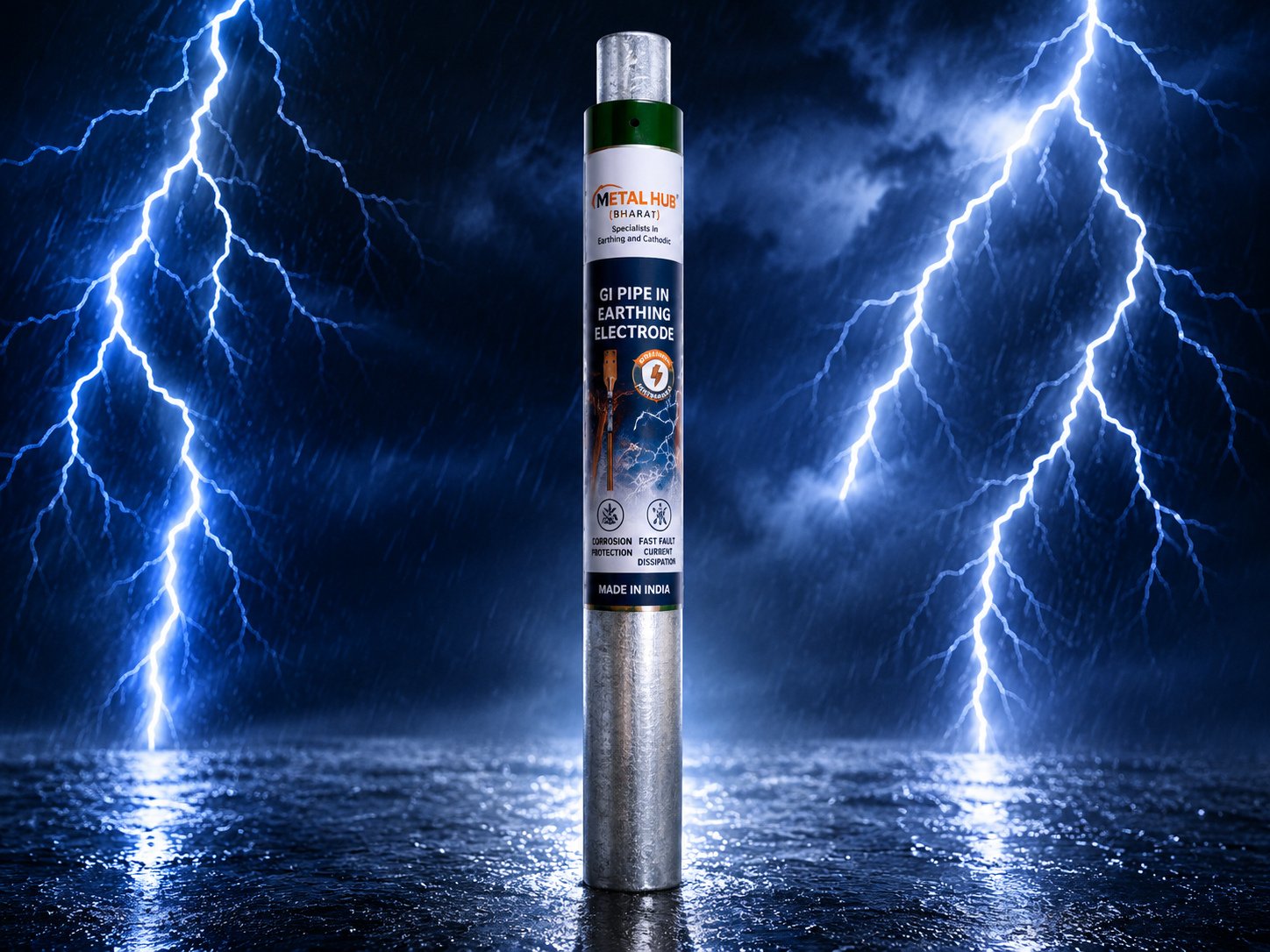
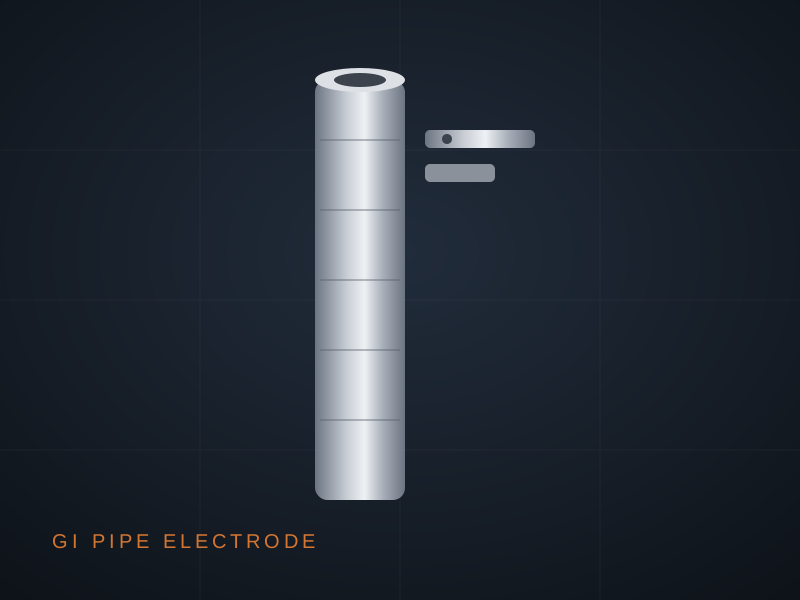
Our GI pipe earthing electrodes are built from mild steel pipe, hot-dip galvanized inside and out for uniform zinc protection. The galvanized coating shields the steel from soil corrosion, giving a long service life at a fraction of the cost of copper systems.
Filled and surrounded with conductive compound, the electrode maintains low earth resistance in soils with pH 5.0 to 8.0 — the right choice for homes, shops, offices, pumps and light industrial loads.
| Material | Mild steel pipe, hot-dip galvanized |
|---|---|
| Standard Diameters | 48 mm, 76 mm, 88 mm |
| Standard Lengths | 2 m, 3 m |
| Coating | Hot-dip zinc, inside and outside surfaces |
| Suitable Soil pH | 5.0 – 8.0 |
| Maintenance | Maintenance-free |
Not every earth pit needs copper. A hot-dip galvanized (GI) pipe electrode delivers dependable, standards-aligned earthing at a fraction of copper's cost — and for residential buildings, shops, pumps, street lighting and light industrial loads, that is exactly the right engineering choice.
The protection mechanism is sacrificial: the zinc coating corrodes preferentially and slowly, shielding the steel beneath. Hot-dip galvanizing — dipping the finished pipe in molten zinc at about 450 °C — creates a metallurgically alloyed coating over every surface, inside and out, including weld areas. This is fundamentally more durable than electro-galvanized or painted finishes, which deposit only a thin surface film.
The engineering honesty here is service life: expect 10 – 15 years in normal soil against 30+ for copper bonded. For a large class of applications that is a perfectly sound trade — provided the coating is genuinely hot-dip and genuinely thick, which is where market-grade GI earthing most often cheats.
Metal Hub GI electrodes are galvanized to a minimum coating aligned with hot-dip standards, supplied compound-charged, and behave as maintenance-free units — no watering, no salt, no periodic recharge.
Good to know: If a GI electrode quote seems too cheap, ask for the zinc coating thickness in microns. Thin electro-galvanized pipe can lose its protection in as little as 2 – 3 monsoons.
Zinc sits below iron in the galvanic series, so wherever soil moisture contacts the electrode, zinc oxidises first and the steel stays protected — even at small scratches, where the surrounding zinc protects the exposed steel cathodically. Corrosion consumes the coating at a roughly predictable rate, which is why coating thickness translates directly into service life.
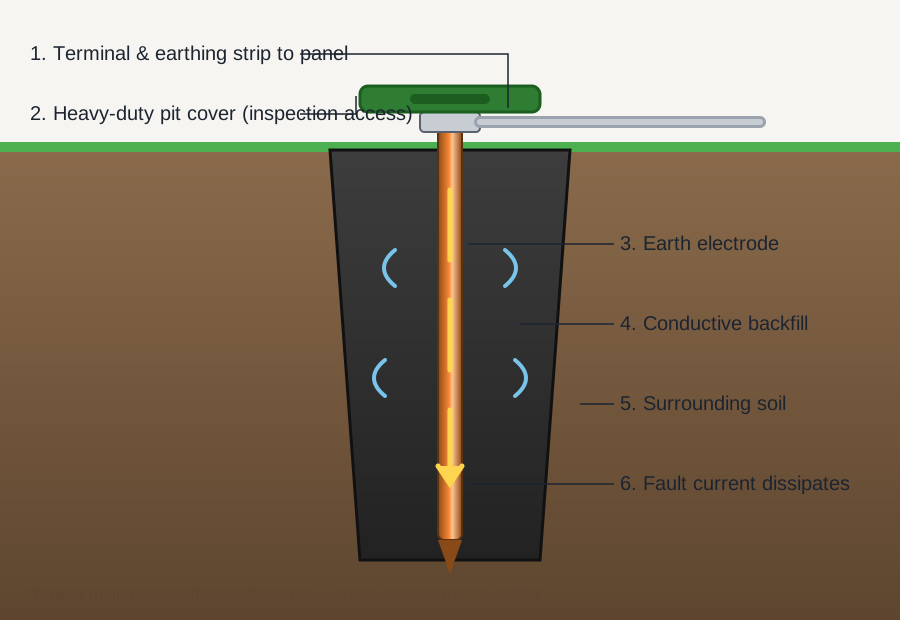
Functionally the pit works exactly like any modern maintenance-free installation: the pipe provides the dissipation surface, the conductive compound holds moisture and lowers interface resistance, and the inspection cover keeps the terminal testable.
| Nominal diameter | Length | Typical application |
|---|---|---|
| 48 mm | 2 m / 3 m | Residential, shops, street lighting |
| 76 mm | 2 m / 3 m | Commercial buildings, pump sets, DG earthing |
| 88 mm | 3 m | Light industrial and panel earthing |
| Property | Value | Why it matters |
|---|---|---|
| Pipe material | Mild steel, medium class | Structural robustness in soil |
| Galvanizing method | Hot-dip, inside and outside | Alloyed coating on all surfaces |
| Coating benchmark | Per IS 4736 / IS 2629 practice | Predictable sacrificial life |
| Fill | Conductive compound charge | Maintenance-free moisture retention |
| Suitable soil pH | 5.0 – 8.0 | Standard Indian soil range |
| Standard | Title / scope | Relevance to this product |
|---|---|---|
| IS 3043 | Code of practice for earthing | System design, electrode sizing, target resistance values |
| IS 2309 | Protection of buildings against lightning | Down conductors, terminations and earthing of LPS |
| IEC 62561-2 | Lightning protection system components | Requirements for conductors and earth electrodes |
| IEC 62305 | Protection against lightning (series) | Risk assessment and protection measures |
| UL 467 | Grounding and bonding equipment | North-American benchmark for electrode hardware |
| IS 4736 / IS 2629 | Hot-dip galvanizing of steel | Coating quality benchmark for GI electrodes |
Indicative values used for first-pass design; always confirm with an on-site soil resistivity test.
| Soil type | Typical resistivity (ohm-m) | Earthing difficulty |
|---|---|---|
| Wet marshy / organic soil | 5 – 40 | Easiest — lowest resistance per electrode |
| Clay / loam (moist) | 20 – 100 | Easy |
| Clay-sand mixtures | 80 – 250 | Moderate |
| Sand / gravel (moist) | 250 – 500 | Hard — backfill compound recommended |
| Dry sand / murram | 500 – 1000 | Very hard — multiple electrodes + compound |
| Rock / hard strata | 1000+ | Requires engineered multi-electrode design |
| Scenario | GI pipe suitable? | Notes |
|---|---|---|
| Residential building earthing | Yes — recommended | Best value for ≤ 8 ohm targets |
| Shop / office / small commercial | Yes | Pair with compound for stable values |
| Borewell pump / agricultural | Yes | Robust and economical in open ground |
| Industrial plant with HT supply | Prefer copper bonded | Longer life and lower resistance |
| Lightning protection termination | Prefer copper bonded / pure copper | Impulse duty favours copper |
| Corrosive / coastal soil | No — use copper bonded | Zinc consumed too quickly |
| Parameter | GI pipe | Copper bonded | Pure copper |
|---|---|---|---|
| Relative cost | Lowest | Medium | High |
| Service life (normal soil) | 10 – 15 years | 30+ years | 40+ years |
| Theft risk | Lowest | Low | High |
| Best fit | Residential & light duty | General default | Critical installations |
Choose moist ground at least 1.5 m from the foundation and clear of drainage that carries detergents or chemicals, which attack zinc.
Bore 150 mm diameter (or excavate a small pit) to the electrode length — typically 3 m.
Lower the electrode centrally with the terminal roughly 150 mm below finished ground level.
Fill the annulus with compound slurry in stages, rodding out voids. Never use salt or charcoal with a GI electrode.
Bolt the GI strip to the terminal with GI hardware, then protect the joint with bitumen or anti-corrosive paste.
Install the FRP cover, allow 48 hours' settlement, then record the baseline fall-of-potential resistance.
GI earthing is maintenance-free in operation, but because protection is sacrificial, verification matters more than with copper systems. The annual test is your window into how much zinc remains.
Watch the trend rather than single readings: a slow steady rise in resistance year over year usually indicates coating consumption or joint corrosion, and tells you when replacement should be budgeted — before the system drifts out of specification.
In normal pH 5 – 8 soil with proper hot-dip coating, plan on 10 – 15 years. Life scales almost linearly with zinc thickness, which is why we publish and stand behind our coating specification.
Traditional pipe-salt-charcoal pits depend on dissolved salt for conductivity, which washes away and corrodes the pipe. Modern compound-charged electrodes hold moisture hygroscopically — no watering, no salt, far longer pipe life.
Above ground with bimetallic connectors, yes. Below ground, keep each pit's buried metal uniform; direct copper-to-zinc contact in soil consumes the zinc rapidly.
Yes — for LT commercial and light industrial duty it is standard practice and fully aligned with IS 3043, provided target resistance is achieved and verified annually.
48 mm covers residential duty; 76 mm is the common commercial choice; 88 mm suits heavier light-industrial installations. Diameter adds surface area and mechanical robustness rather than dramatically changing resistance.
It needs the standard conductive compound — and specifically not salt. Salt-based backfills are the single most common cause of premature GI electrode failure.
Share sizes and quantities — we'll quote the same working day.