The premium choice — 100% electrolytic copper construction for installations that demand the lowest possible earth resistance.
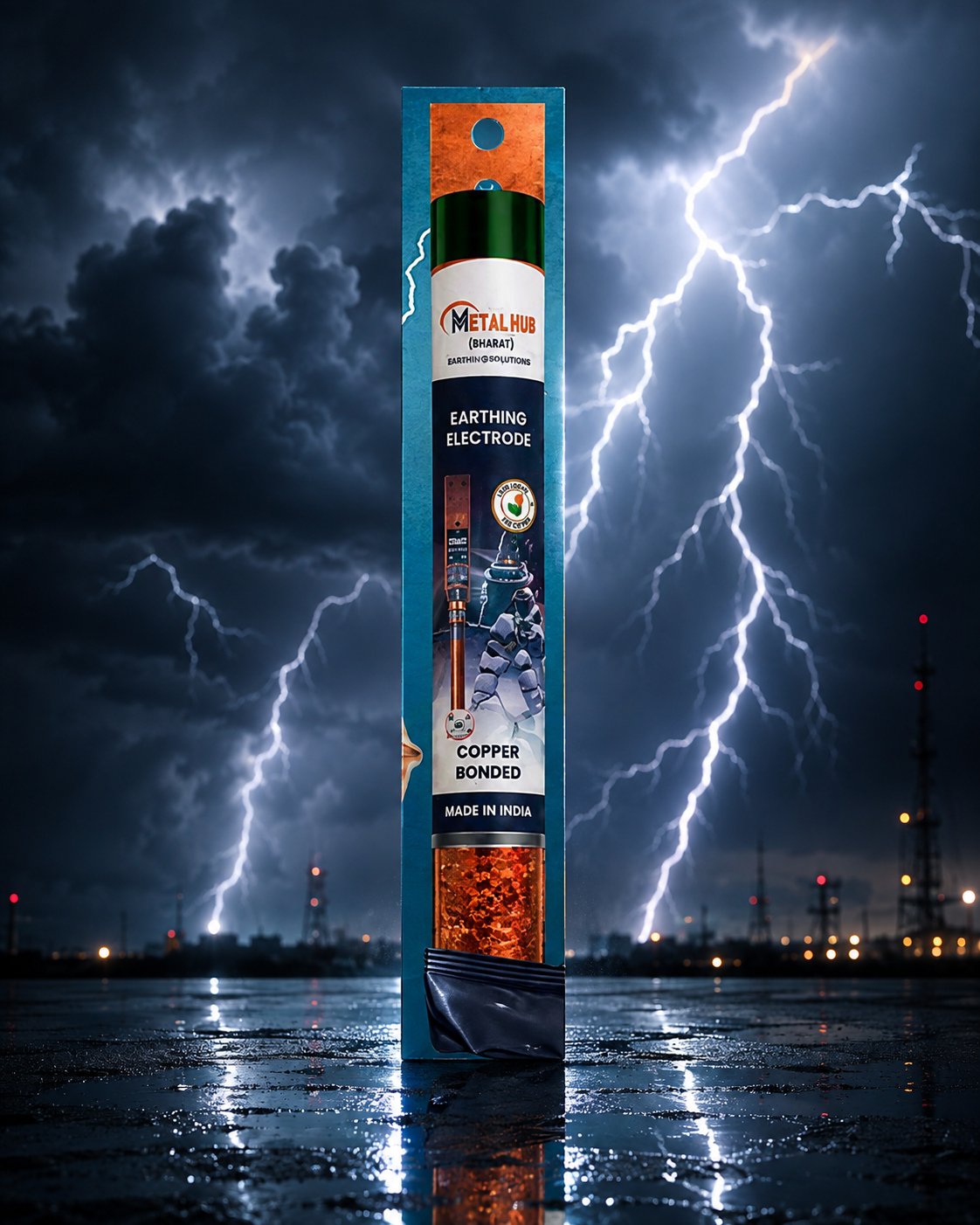
Manufactured from 99.9% pure electrolytic copper in a pipe-in-pipe construction, our pure copper earthing electrodes deliver the highest conductivity of any electrode type. The annular space is filled with conductive compound, creating a low-impedance path that stays stable across seasons.
Copper's natural corrosion resistance means the electrode performs for decades in soils with pH between 5.0 and 8.0 — completely maintenance-free, with no watering or recharging required.
| Material | 99.9% pure electrolytic copper |
|---|---|
| Construction | Pipe-in-pipe with conductive compound fill |
| Standard Diameters | 50 mm, 80 mm (custom sizes on request) |
| Standard Lengths | 1 m, 2 m, 3 m |
| Suitable Soil pH | 5.0 – 8.0 |
| Maintenance | Maintenance-free |
Where the consequences of an earthing failure are unacceptable — hospital operating theatres, defence installations, data centres, HV substations — designers specify solid copper. With conductivity of roughly 100% IACS and a natural passivating oxide layer, 99.9% electrolytic copper offers the lowest achievable resistance per unit surface area and the longest corrosion life of any practical electrode material.
Metal Hub pure copper electrodes use a pipe-in-pipe construction: an outer copper pipe and an inner copper pipe with the annular space factory-filled with conductive compound. This multiplies the effective dissipation surface, adds thermal mass to absorb repeated lightning discharges without heating, and ensures the electrode's performance does not depend on how well site labour charges the pit.
Copper's key electrical advantage under lightning conditions is its behaviour at high frequency. Impulse currents travel on the conductor surface (skin effect), and copper's low surface resistivity keeps the impulse impedance of the earth termination low precisely when it matters most.
The honest trade-offs are cost and theft risk. Where budgets are tight or site security is weak, the copper bonded electrode delivers most of the performance at lower cost — which is why we position pure copper as the critical-installation choice rather than the universal default.
Good to know: For lightning-heavy sites, pairing a pure copper electrode with copper strip and exothermic-welded joints creates a fully homogeneous copper path — no galvanic couples anywhere below ground.
Earth resistance is inversely related to the surface area in contact with conductive ground. A pipe electrode beats a solid rod of the same weight because the material is distributed at a larger diameter; the pipe-in-pipe design goes further by adding an internal dissipation path through the factory compound fill.
The compound between the pipes is hygroscopic — it draws and holds soil moisture, maintaining a wet conductive bridge between copper and soil across seasons. Combined with the external backfill placed at installation, the electrode sits inside two concentric moisture-retaining zones.
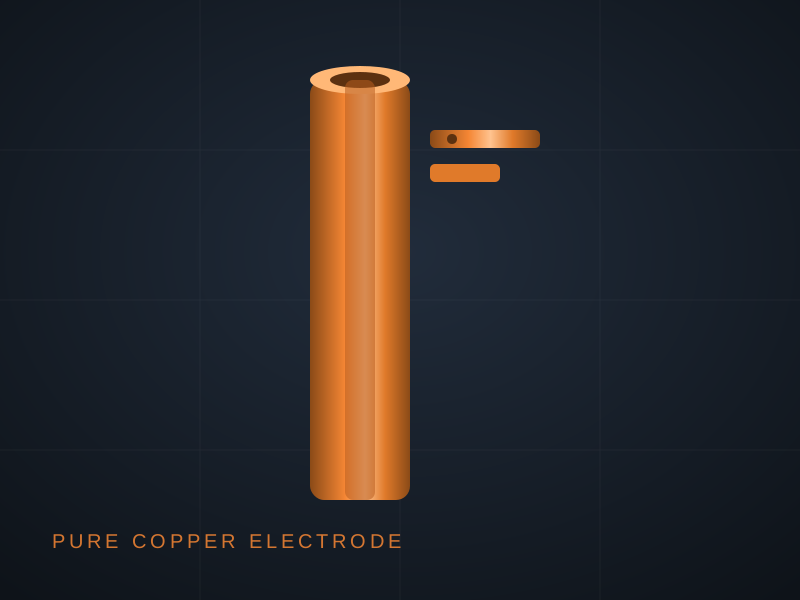
Other diameters and lengths are manufactured to order.
| Outer diameter | Length | Construction | Typical application |
|---|---|---|---|
| 50 mm | 2 m / 3 m | Pipe-in-pipe, compound filled | Commercial and institutional earthing |
| 80 mm | 2 m / 3 m | Pipe-in-pipe, compound filled | Substations, hospitals, data centres |
| Property | Value | Why it matters |
|---|---|---|
| Copper purity | 99.9% electrolytic grade | Highest conductivity, slowest corrosion |
| Conductivity | ≈ 100% IACS | Lowest resistance per unit area |
| Melting point | 1083 °C | Absorbs repeated impulse energy safely |
| Corrosion behaviour | Self-passivating oxide film | Decades of life in pH 5 – 8 soils |
| Fill | Factory conductive compound | Performance independent of site workmanship |
| Standard | Title / scope | Relevance to this product |
|---|---|---|
| IS 3043 | Code of practice for earthing | System design, electrode sizing, target resistance values |
| IS 2309 | Protection of buildings against lightning | Down conductors, terminations and earthing of LPS |
| IEC 62561-2 | Lightning protection system components | Requirements for conductors and earth electrodes |
| IEC 62305 | Protection against lightning (series) | Risk assessment and protection measures |
| UL 467 | Grounding and bonding equipment | North-American benchmark for electrode hardware |
Indicative values used for first-pass design; always confirm with an on-site soil resistivity test.
| Soil type | Typical resistivity (ohm-m) | Earthing difficulty |
|---|---|---|
| Wet marshy / organic soil | 5 – 40 | Easiest — lowest resistance per electrode |
| Clay / loam (moist) | 20 – 100 | Easy |
| Clay-sand mixtures | 80 – 250 | Moderate |
| Sand / gravel (moist) | 250 – 500 | Hard — backfill compound recommended |
| Dry sand / murram | 500 – 1000 | Very hard — multiple electrodes + compound |
| Rock / hard strata | 1000+ | Requires engineered multi-electrode design |
| Scenario | Recommended electrode | Reason |
|---|---|---|
| Hospital / laboratory / clean earth | Pure copper | Lowest noise floor and most stable reference |
| HV substation earth grid termination | Pure copper | High fault energy, homogeneous copper path |
| Lightning-prone tall structures | Pure copper | Best impulse behaviour and thermal mass |
| General industrial / commercial | Copper bonded | 90% of the performance at lower cost |
| Theft-prone open sites | Copper bonded | Lower scrap attractiveness |
| Budget residential | GI pipe | Adequate protection at minimum cost |
| Parameter | Pure copper | Copper bonded | GI pipe |
|---|---|---|---|
| Conductivity | Excellent | Excellent | Good |
| Corrosion life | 40+ years | 30+ years | 10 – 15 years |
| Impulse (lightning) behaviour | Best | Very good | Adequate |
| Relative cost | High | Medium | Low |
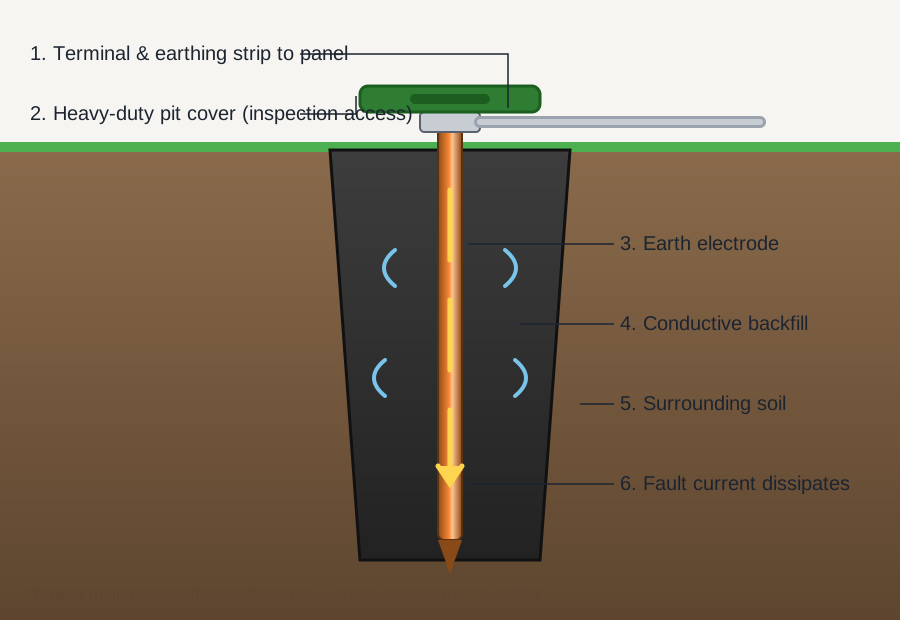
Select moist, undisturbed ground clear of foundations and services; maintain spacing from other electrodes of at least one electrode length.
Bore 150 – 200 mm diameter to electrode length; the larger diameter suits the 50/80 mm electrode plus backfill annulus.
Lower — never hammer — the electrode into the bore, keeping the terminal about 150 mm below finished level.
Pour compound slurry in stages around the electrode, rodding out air pockets for a void-free conductive column.
Connect copper strip with a copper alloy clamp or exothermic weld to keep the below-ground path galvanically uniform.
Fit the FRP inspection cover and label the pit ID for the test register.
Record fall-of-potential resistance after settlement; file with commissioning documents.
Copper's passivating chemistry makes this the lowest-maintenance electrode we manufacture. The oxide film that forms on the surface is itself stable and does not flake, so the electrode's soil interface remains intact for decades.
Verification requirements are identical to any earth pit: an annual resistance measurement logged against baseline, and inspection of the terminal joint. For clean-earth installations serving instrumentation, many facilities also log earth loop impedance at the equipment end.
Because some failures cost more than electrodes. Where the earth serves life-safety systems, HV switchgear or sensitive instrumentation, the extra conductivity, thermal mass and 40+ year life of solid copper are worth the premium.
A second dissipation surface and a factory-controlled conductive fill. Performance stops depending on how carefully site labour mixes and places compound — the critical inner annulus is done in the factory.
Yes — it is the preferred termination. Copper's surface conductivity keeps impulse impedance low, and its thermal mass absorbs repeated strikes without degradation.
Above ground, yes — through a bimetallic connector that separates the metals. Below ground, avoid it: the galvanic couple corrodes the zinc rapidly. Use copper strip below grade.
Soils of pH 5.0 – 8.0, which covers most of India. In highly acidic or sulphate-rich soils, consult our engineers for a soil-specific recommendation.
50 mm and 80 mm outer diameter in 2 m and 3 m lengths as standard; custom dimensions are manufactured against order.
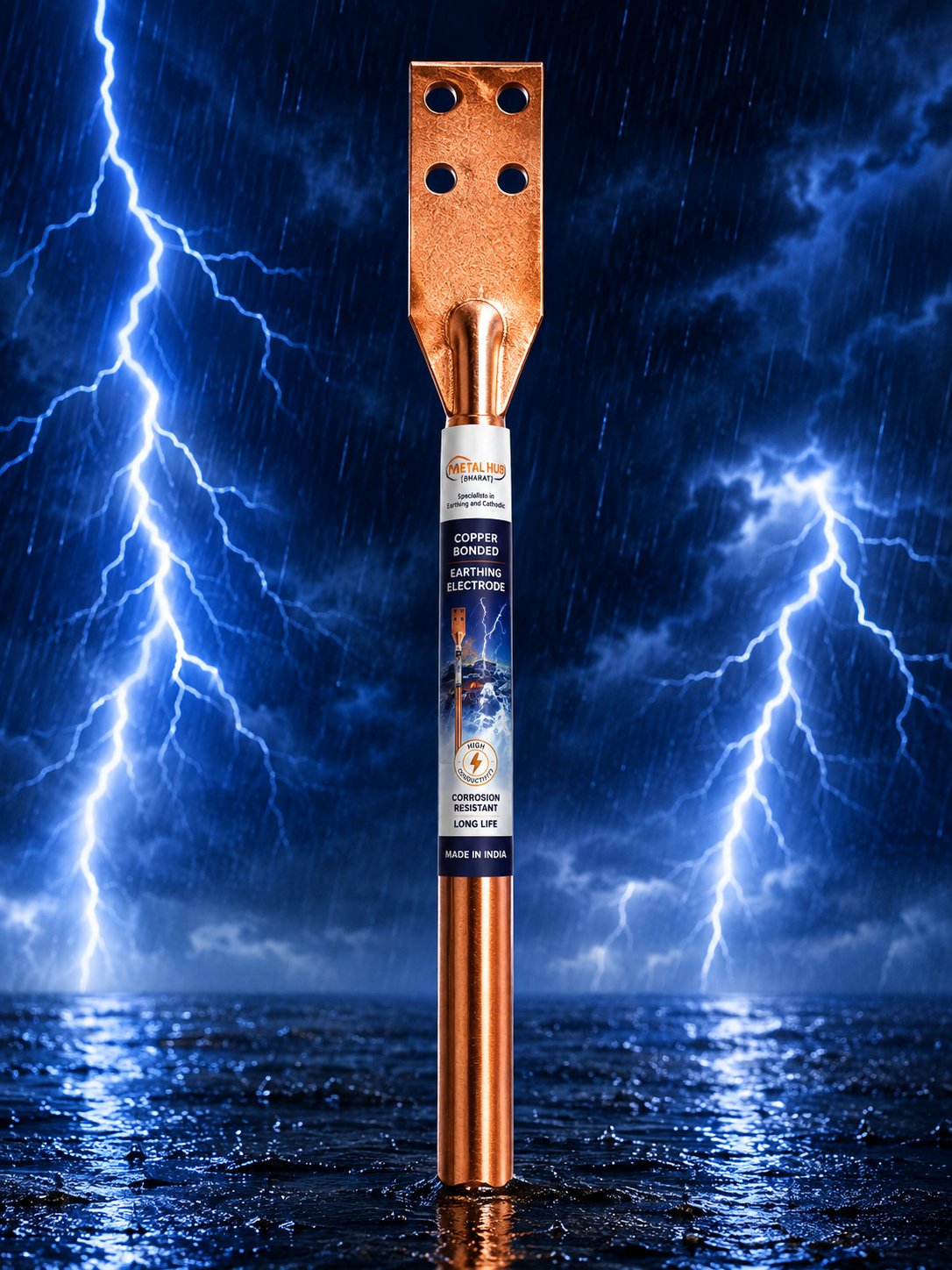
NABL & CPRI lab-tested electrodes with molecularly bonded copper coating.
View Details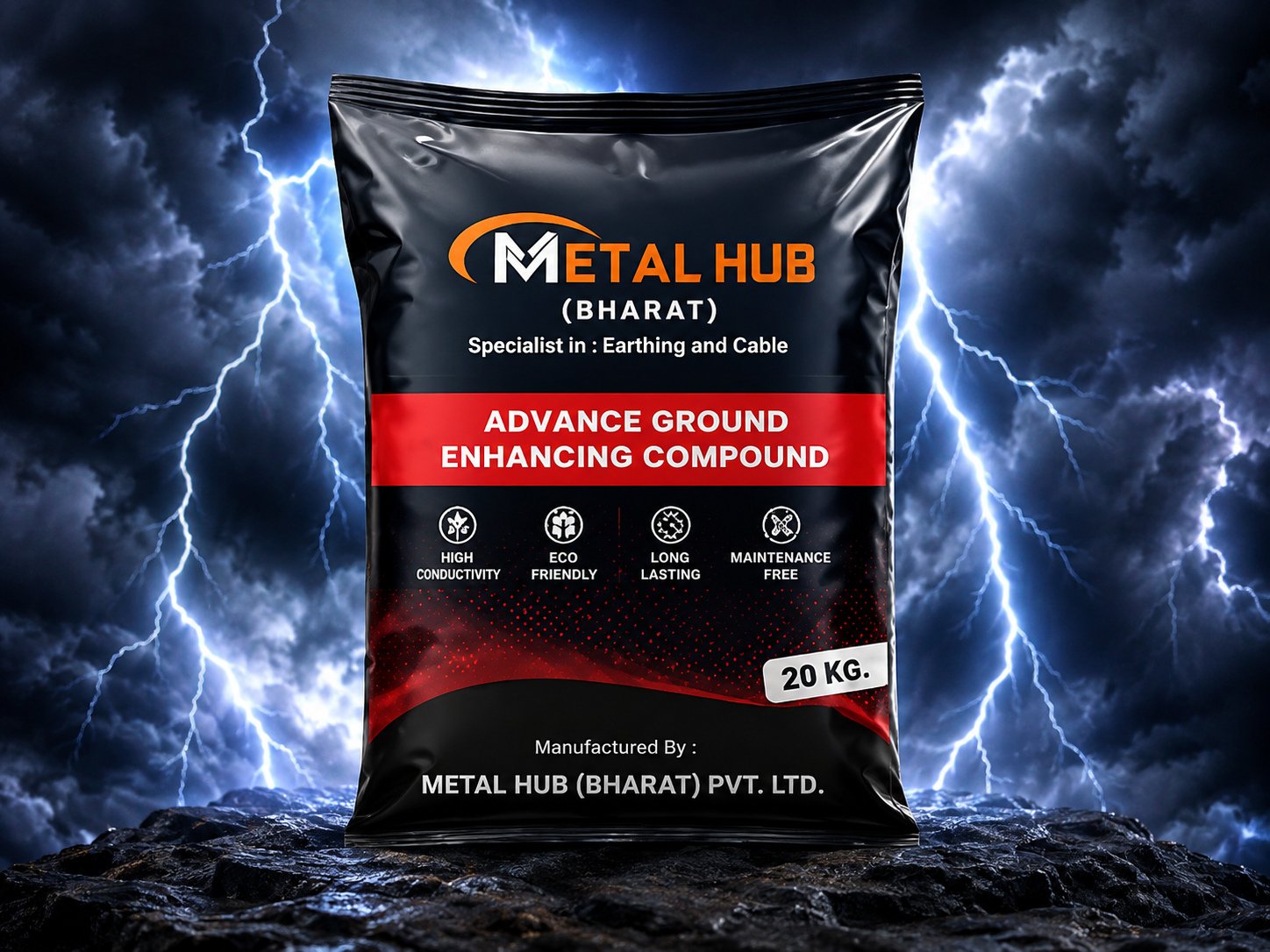
Graphite-based ground enhancing compound, resistivity below 0.2 ohm-m.
View Details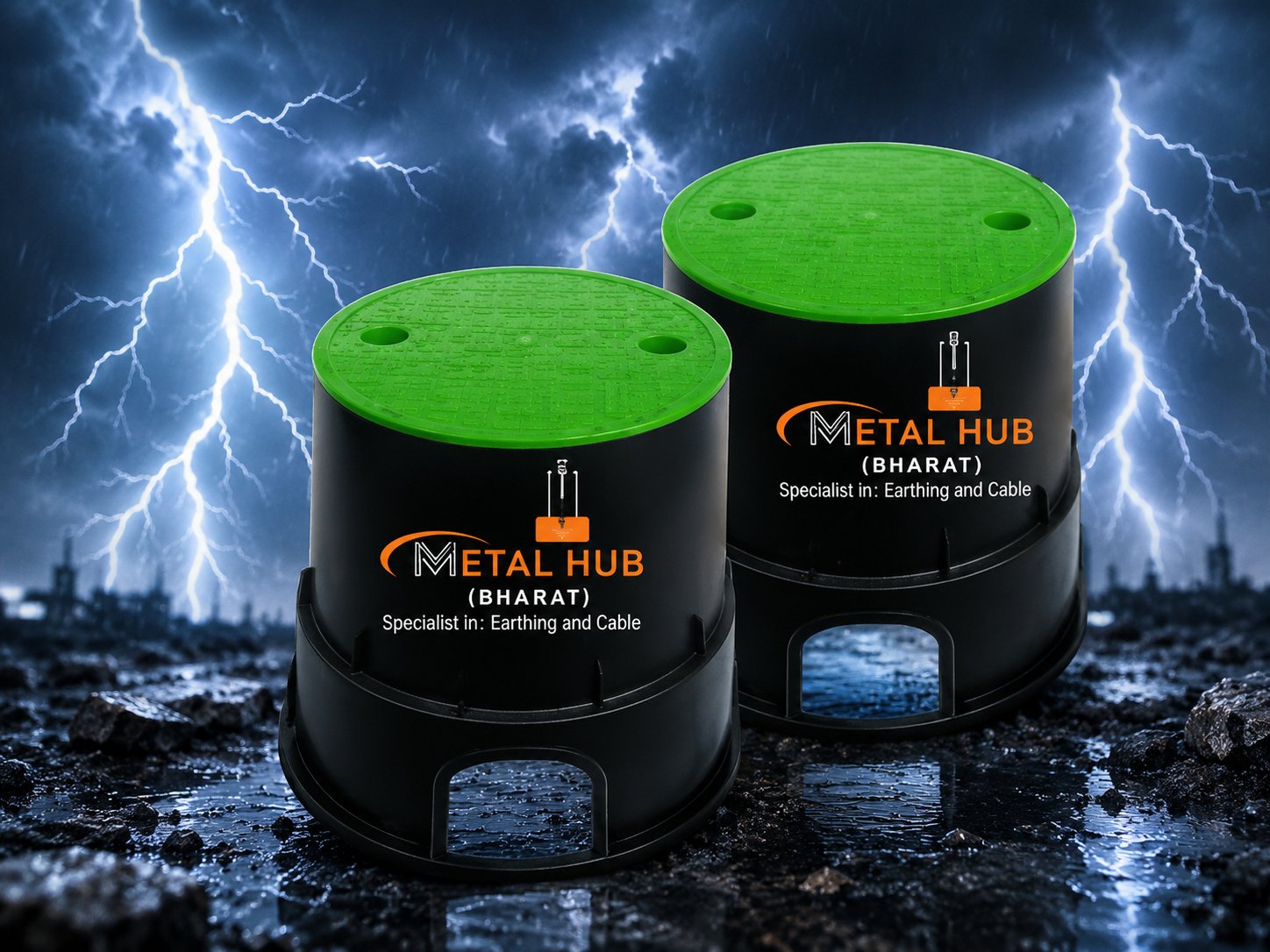
Corrosion-proof covers with factory-built access holes.
View DetailsShare sizes and quantities — we'll quote the same working day.